
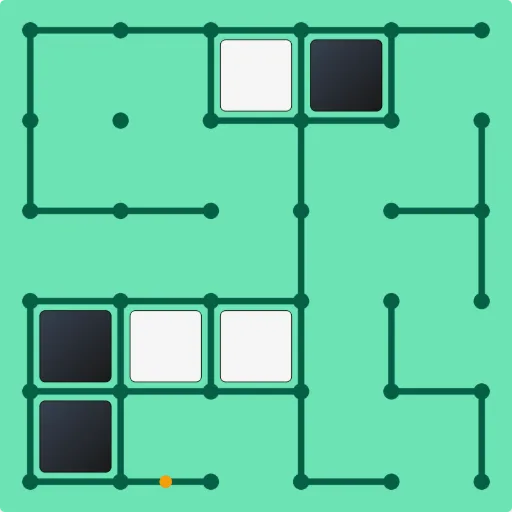
Dots and Boxes is a two-player pencil-and-paper classic first published by the French mathematician Edouard Lucas in 1889 under the name La Pipopipette. Players take turns joining two neighbouring dots with a single line, and whoever draws the fourth side of a small square claims that box and immediately draws again. It looks like a children's doodle, but the endgame is a precise battle over chains and parity that has been studied seriously by combinatorial game theorists.
Dots and Boxes Strategy: Tips, Tactics & Openings
Dots and Boxes is a two-player pencil-and-paper classic first published by the French mathematician Edouard Lucas in 1889 under the name La Pipopipette. Players take turns joining two neighbouring dots with a single line, and whoever draws the fourth side of a small square claims that box and immediately draws again. It looks like a children's doodle, but the endgame is a precise battle over chains and parity that has been studied seriously by combinatorial game theorists.
Never Give Away the Third Side
The single biggest mistake is drawing the third side of a box, because your opponent simply takes it and keeps moving. In the opening, restrict yourself to lines that touch only empty boxes or boxes with one side. Those are your safe moves, and the player who runs out of them first is the one forced to open the position.
Count Safe Moves, Not Boxes
Early on the score is meaningless because no boxes exist yet. What matters is how many harmless lines are left. Before every move, look at how many safe segments remain. If the number is odd or even in your favour, you can steer the game so that your opponent is the one who has to hand over the first chain.
Think in Chains
Once the safe moves run out, the board resolves into chains: runs of boxes that all fall together the moment one of them is opened. A chain of three or four boxes is a big gift. Long chains decide the game, so learn to see them forming several moves before they are forced open, and try to make sure your opponent has to open the longest one.
Master the Double Cross
When your opponent opens a chain, you do not always have to eat all of it. By taking every box except the last two and then drawing the line that splits them, you hand back two boxes but force your opponent to open the next chain. This sacrifice, known as the double cross, is how strong players keep control of the endgame and it usually gains far more than the two boxes it costs.
Play the Parity
With long chains and correct double crossing, the winner is often determined by whether the number of long chains is odd or even. As a rough guide on a 5x5 board, the first player wants an even number of long chains and the second player wants an odd number. Loops, which are closed rings of boxes, cost four boxes to double cross instead of two, so they shift the count in their own way. Steering the shape of the board toward the right chain count is the deepest layer of the game.
Never Give Away the Third Side
The single biggest mistake is drawing the third side of a box, because your opponent simply takes it and keeps moving. In the opening, restrict yourself to lines that touch only empty boxes or boxes with one side. Those are your safe moves, and the player who runs out of them first is the one forced to open the position.
Count Safe Moves, Not Boxes
Early on the score is meaningless because no boxes exist yet. What matters is how many harmless lines are left. Before every move, look at how many safe segments remain. If the number is odd or even in your favour, you can steer the game so that your opponent is the one who has to hand over the first chain.
Think in Chains
Once the safe moves run out, the board resolves into chains: runs of boxes that all fall together the moment one of them is opened. A chain of three or four boxes is a big gift. Long chains decide the game, so learn to see them forming several moves before they are forced open, and try to make sure your opponent has to open the longest one.
Master the Double Cross
When your opponent opens a chain, you do not always have to eat all of it. By taking every box except the last two and then drawing the line that splits them, you hand back two boxes but force your opponent to open the next chain. This sacrifice, known as the double cross, is how strong players keep control of the endgame and it usually gains far more than the two boxes it costs.
Play the Parity
With long chains and correct double crossing, the winner is often determined by whether the number of long chains is odd or even. As a rough guide on a 5x5 board, the first player wants an even number of long chains and the second player wants an odd number. Loops, which are closed rings of boxes, cost four boxes to double cross instead of two, so they shift the count in their own way. Steering the shape of the board toward the right chain count is the deepest layer of the game.
Learn, Play, and Have Fun!
Ready to play Dots and Boxes online? Start a match against the computer now. No signup, no friction.