
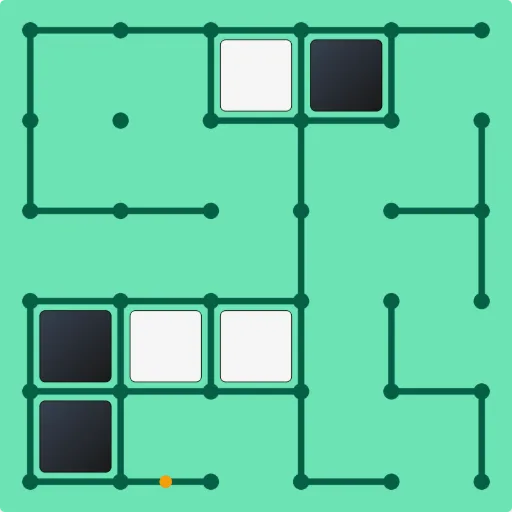
Dots and Boxes is a two-player pencil-and-paper classic first published by the French mathematician Edouard Lucas in 1889 under the name La Pipopipette. Players take turns joining two neighbouring dots with a single line, and whoever draws the fourth side of a small square claims that box and immediately draws again. It looks like a children's doodle, but the endgame is a precise battle over chains and parity that has been studied seriously by combinatorial game theorists.
How to Play Dots and Boxes: Learn the Rules
Dots and Boxes is a two-player pencil-and-paper classic first published by the French mathematician Edouard Lucas in 1889 under the name La Pipopipette. Players take turns joining two neighbouring dots with a single line, and whoever draws the fourth side of a small square claims that box and immediately draws again. It looks like a children's doodle, but the endgame is a precise battle over chains and parity that has been studied seriously by combinatorial game theorists.
Objective
Claim more boxes than your opponent. On the standard 5x5 grid there are 25 boxes, so the first player to reach 13 has won the game outright.
Setup
The board is a lattice of 6 by 6 dots, forming a 5 by 5 field of small square boxes and 60 line segments that can be drawn. No lines are drawn at the start. Player 1 moves first.
Gameplay
On your turn you draw exactly one line between two horizontally or vertically adjacent dots. Diagonals are not allowed, and a segment that has already been drawn cannot be drawn again. If your line completes the fourth side of a box, that box is marked as yours and you must move again. A single line can close two boxes at once when it sits between them, and you still take just one extra turn. If your line completes no box, the turn passes to your opponent.
Winning
Play continues until all 60 segments are drawn, at which point every box has an owner. The player holding the most boxes wins. On the 5x5 grid the odd number of boxes makes a tie impossible, but on an even-sized grid the game can end in a draw.
Objective
Claim more boxes than your opponent. On the standard 5x5 grid there are 25 boxes, so the first player to reach 13 has won the game outright.
Setup
The board is a lattice of 6 by 6 dots, forming a 5 by 5 field of small square boxes and 60 line segments that can be drawn. No lines are drawn at the start. Player 1 moves first.
Gameplay
On your turn you draw exactly one line between two horizontally or vertically adjacent dots. Diagonals are not allowed, and a segment that has already been drawn cannot be drawn again. If your line completes the fourth side of a box, that box is marked as yours and you must move again. A single line can close two boxes at once when it sits between them, and you still take just one extra turn. If your line completes no box, the turn passes to your opponent.
Winning
Play continues until all 60 segments are drawn, at which point every box has an owner. The player holding the most boxes wins. On the 5x5 grid the odd number of boxes makes a tie impossible, but on an even-sized grid the game can end in a draw.
Learn, Play, and Have Fun!
Ready to play Dots and Boxes online? Start a match against the computer now. No signup, no friction.