
Play Mangala online
Sow, chain extra turns and capture the pits you make even.
Play Mangala online for free, right in your browser: against the computer, with a friend online, or with two players on one device. No download and no sign-up. The site plays the rules used in Turkish school tournaments, and they take a minute to learn.
Ways to play Mangala online










More ways to play
What is Mangala?
Mangala is the mancala game of Turkey, played in schools and tournaments all over the country. The board has two rows of six pits, a store at each end and 48 seeds. You pick up all the seeds in one of your pits, put the first one back, and sow the rest around the board. A last seed in your store gives you another turn, and a last seed that leaves an even number in one of your opponent's pits captures them.
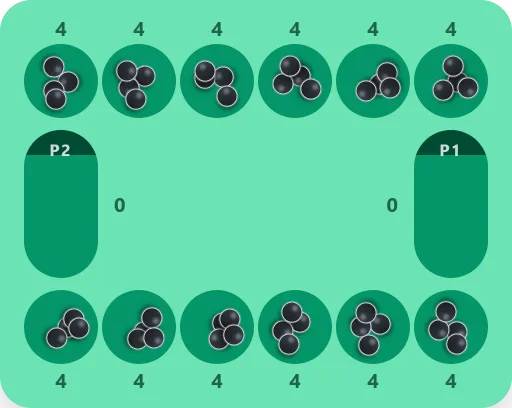
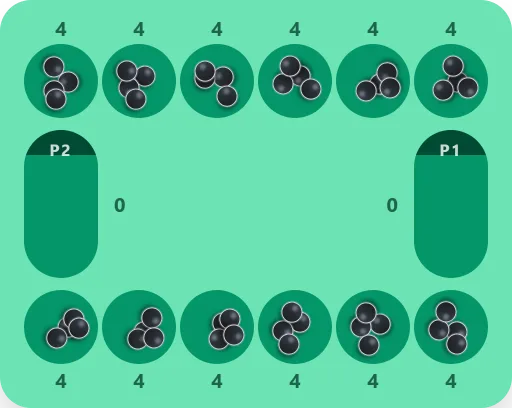
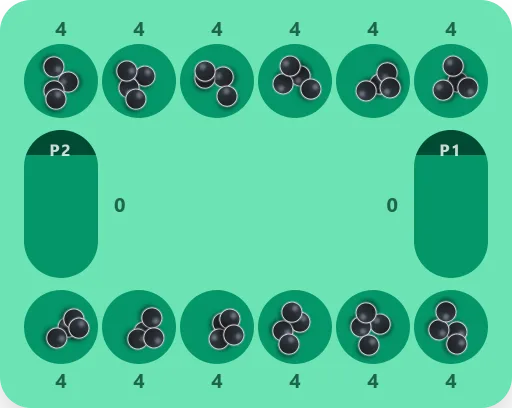
In this guide the first player sits at the bottom of the board and is called South, the other player North. On the boards below, the number above or below each pit is how many seeds it holds, and the number beside each store is its total.
Mangala keeps the extra turns that make Kalah lively and adds a capture that can strike anywhere on your opponent's row: every pit with an odd number of seeds is one seed away from being taken. Because the first seed stays at home, the counting is a little different from other mancala games, and that small change keeps even experienced players on their toes.
The ending is where Mangala is most its own. The player who runs out of seeds first takes everything left on the board, so a lead in the store can vanish in the last few moves.
How to play Mangala in one minute
- Each pit starts with four seeds. South moves first.
- On your turn, take all the seeds from one of your pits. Drop the first one back into that pit and sow the rest counter-clockwise, one per pit, through your own store. A single seed moves on to the next pit.
- If your last seed falls in your store, sow again.
- If your last seed makes a pit on your opponent's side even, capture its seeds. If it falls in an empty pit of your own, capture it and the seeds in the pit facing it.
- When a row is empty the game ends, and the player who ran out takes every seed left on the board. Most seeds wins.
Make your move on the board.
Show the answer
Sow the fourth pit. One of its four seeds stays at home and the other three reach the store exactly, so South sows again.
That is the whole game. The full Mangala rules go through every rule with boards you can play: the lone seed, extra turns, both captures, how the game ends and how other rule sets differ.
Mangala strategy in three ideas
Mangala is a game of counting, and of knowing when to run out. These three ideas are where good play starts.
Mangala and the other Mancala games
Mangala is one game of the large Mancala family, all played by sowing seeds around a board of pits. It is closest to Kalah, with the same board, stores and extra turns, but Kalah sows from the next pit, captures only from your own empty pits and lets each player keep their own row at the end. Oware, the great game of West Africa, has no extra turns and captures twos and threes.
History and names
Mancala games have been played in Anatolia for centuries. Ottoman miniatures show players at mancala boards from the 16th century, and the English scholar Thomas Hyde described the game in 1694. Many towns had their own version, on boards of six or seven pits a side.
The Mangala played in Turkey today is a standardised version, taught in schools as part of mind and strategy games lessons and played in school tournaments under the rules of the Ministry of National Education. Those are the rules this site plays.
Mangala is the Turkish name of the game, from the same Arabic root as mancala, to move. The store at each end is called the hazine, the treasure; the pits are kuyu, wells; and the seeds are taş, stones, since Turkish sets are usually played with small stones or glass beads.
Mangala questions
Mangala is one of the Mancala games, a family of games played by sowing seeds around pits. The board sold as Mancala in North America and Europe usually comes with the rules of Kalah, a close relative; Mangala is the version played in Turkey.
Have more seeds in your store than your opponent when the game ends. With 48 seeds, 25 or more always wins, and 24 each is a draw.
That is simply the Mangala rule: you lift every seed, drop the first one back where it came from and sow the rest. Only a pit with a single seed is emptied, because that seed moves on to the next pit.
There are two ways. If your last seed makes a pit on your opponent's side hold an even number, you take all of its seeds. If your last seed falls in an empty pit on your own side and the pit facing it holds seeds, you take those seeds and your last seed.
The game ends as soon as one row is empty. The player whose row ran out takes every seed still on the other row into their store, and then the stores are counted.
Both have stores and extra turns. In Mangala the first seed goes back into the pit you lifted, a last seed that makes an opponent's pit even captures it, and the player who runs out first takes the seeds left on the board. In Kalah you sow from the next pit, capture only from your own empty pits, and each player keeps their own row at the end.
Yes. Create a room and send your friend the link to play online, or play with two players taking turns on one device.
No. Mangala runs in your browser on a computer, phone or tablet, including iPhone and Android. An account is optional and only keeps your game history and stats.
Similar games you might like
If you enjoy Mangala, you will probably like these other abstract strategy board games.

Learn, Play, and Have Fun!
Ready to play Mangala online? Start a match against the computer now. No signup, no friction.