
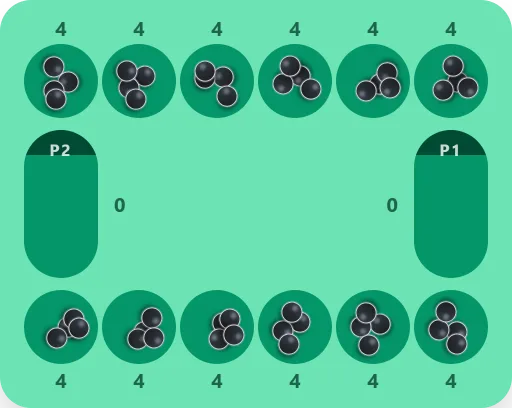
Play Kalah online for free, right in your browser: against the computer, with a friend online, or with two players on one device. No download and no sign-up. Kalah is the game most people mean by Mancala, and the rules take a minute.
Ways to play Kalah online










More ways to play
What is Kalah?
Kalah is a two-player game of the Mancala family, the oldest family of board games still played. The board has two rows of six pits and a large pit at each end, the store. You pick up all the seeds in one of your pits and sow them, one by one, into the pits that follow. Seeds that reach your store are yours for good.
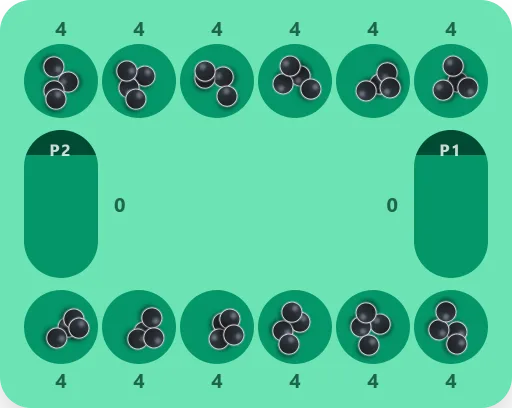
In this guide the first player sits at the bottom of the board and is called South, the other player North. On the boards below, the number above or below each pit is how many seeds it holds, and the number beside each store is its total.
A game takes ten minutes, and every move is a small sum: count the seeds in a pit and you know exactly where the last one will land. That makes Kalah a favourite in classrooms and families, and a real puzzle for anyone who likes to plan.
Good players chain one extra turn into the next, set up captures their opponent cannot stop, and count the seeds left on both rows long before the end.
How to play Kalah in one minute
- Each pit starts with four seeds, and both stores are empty. South moves first.
- On your turn, take all the seeds from one of your pits and sow them counter-clockwise, one per pit, through your own store but not your opponent's.
- If your last seed lands in your store, you sow again.
- If your last seed lands in one of your own empty pits, you capture it and all the seeds in the pit facing it.
- When either row is empty, the game ends. Each player adds the seeds on their own row to their store, and the bigger store wins.
Make your move on the board.
Show the answer
Sow the third pit from the left. It is four pits from the store and holds four seeds, so the last one falls in the store and South sows again. Most games of Kalah start this way.
That is the whole game. The full Kalah rules go through every rule with boards you can play, the edge cases, and the variations you may meet on other boards.
Kalah strategy in three ideas
Kalah rewards counting more than anything. These three ideas are where good play starts.
Kalah and the other Mancala games
Kalah is one game of the large Mancala family, all played by sowing seeds around a board of pits. The closest relative here is Oware, the great game of West Africa: the same 48 seeds on two rows of six pits, but no stores to sow into, captures of two or three seeds on your opponent's side, and a rule that you must feed an opponent who has run out. Mangala, the Turkish game, keeps Kalah's stores and extra turns, but leaves the first seed in the pit it came from, captures even pits on your opponent's side and gives the seeds left at the end to the player who runs out first.
History and other names
Mancala games are thousands of years old, and boards cut into stone have been found across Africa and the Middle East. Kalah itself is much younger. William Julius Champion Jr. devised it in the United States around 1940, simplifying the African games he had studied, and sold it as a boxed game.
It spread through schools and toy shops, and in North America and much of Europe the board sold as Mancala comes with Kalah's rules. Its clear rules also made it one of the first games played by computer programs, and in 2000 researchers solved the standard game with four seeds per pit: with perfect play, the first player wins.
Most people simply call the game Mancala, though that name belongs to the whole family. It is also sold as Kalaha, the usual name in Scandinavia, or Kalahari. Whatever the name on the box, two rows of six pits with a store at each end and four seeds a pit is the game on this page.
Kalah questions
Mostly, yes. Mancala is the name of a whole family of sowing games, but the board sold as Mancala in North America and Europe almost always comes with Kalah's rules: six pits a side, a store at each end, extra turns and captures from an empty pit. That is the game on this page.
South, the player at the bottom of the board, moves first. It is an advantage: a computer analysis showed that with perfect play the first player wins. Players often take turns starting.
You sow again, and again if the next sowing ends in your store too. There is no limit on extra turns.
If your last seed lands in one of your own pits that was empty, and the pit facing it holds seeds, you take that seed and all the seeds facing it into your store. If the facing pit is empty, nothing is captured.
No. Your sowing drops a seed in your own store but skips your opponent's.
The game ends when either row is empty. Each player then adds the seeds still on their own row to their store, and the bigger store wins.
Yes. Create a room and send your friend the link to play online, or play with two players taking turns on one device.
No. Kalah runs in your browser on a computer, phone or tablet, including iPhone and Android. An account is optional and only keeps your game history and stats.
Similar games you might like
If you enjoy Kalah, you will probably like these other abstract strategy board games.

Learn, Play, and Have Fun!
Ready to play Kalah online? Start a match against the computer now. No signup, no friction.