
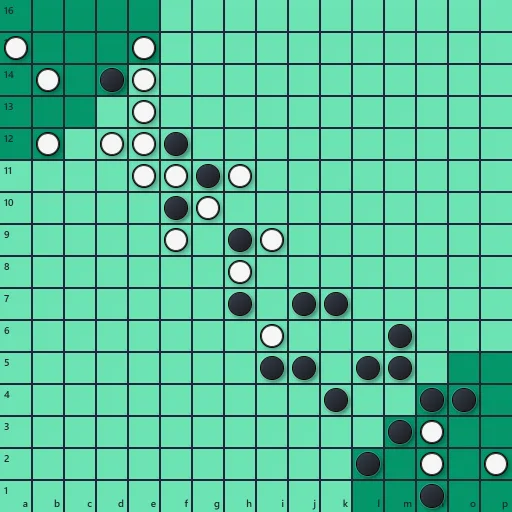
Halma is the original leaping game, invented in 1883 by the American surgeon George Howard Monks, who took his inspiration from an older English game called Hoppity. Its name is the Greek word for 'leap', and leaping is the whole game: on a 16x16 board, each player owns a camp of 19 pieces in one corner and races every one of them into the camp diagonally opposite. Nothing is ever captured. Pieces travel by stepping one square in any direction, or by hopping over a neighbouring piece of either colour into the empty square beyond, chaining hop after hop into ladders that can cross the entire board in a single turn. Halma was later reshaped onto a six-pointed star and sold as Sternhalma, which the world now knows as Chinese Checkers.
Halma Strategy: Tips, Tactics & Openings
Halma is the original leaping game, invented in 1883 by the American surgeon George Howard Monks, who took his inspiration from an older English game called Hoppity. Its name is the Greek word for 'leap', and leaping is the whole game: on a 16x16 board, each player owns a camp of 19 pieces in one corner and races every one of them into the camp diagonally opposite. Nothing is ever captured. Pieces travel by stepping one square in any direction, or by hopping over a neighbouring piece of either colour into the empty square beyond, chaining hop after hop into ladders that can cross the entire board in a single turn. Halma was later reshaped onto a six-pointed star and sold as Sternhalma, which the world now knows as Chinese Checkers.
Build the Ladder
A step advances one square, a chain of hops can advance ten. Spacing your pieces every second square gives each of them something to hop over, so the group works as a ladder that the pieces behind climb. Almost every strong Halma turn is a hop chain, and almost every strong Halma move is one that makes the next chain possible.
Move as One Group
Halma is not a race won by your fastest piece; it is a race that ends when your slowest one arrives. Pushing a single piece far ahead strands it with nothing to hop over, while the pieces it left behind lose the stepping stones they needed. Advance the whole formation together and it feeds itself the whole way across.
Use the Diagonal
The two camps face each other along the main diagonal, which is both the shortest route and the busiest one. Pieces near the diagonal find hops in every direction; pieces that drift into the empty far corners lose their neighbours, their chains, and several turns walking back.
Hop the Opponent
You may hop over any piece, and your opponent's advancing pieces are coming straight towards you. Their formation is a free ladder if you meet it at the right angle, so watch the traffic in the middle of the board for chains that only exist because of their pieces, and think twice before offering them the same gift.
Empty Your Camp Early
The pieces at the very back of your camp are the ones that decide the game, and they are also the last to get moving. Bring the deep corner pieces out early while the board is still crowded enough to hop across. Filling your target camp from its far corner inwards matters too: a camp filled from the front leaves the last arrivals with no empty square left that they are allowed to reach.
Build the Ladder
A step advances one square, a chain of hops can advance ten. Spacing your pieces every second square gives each of them something to hop over, so the group works as a ladder that the pieces behind climb. Almost every strong Halma turn is a hop chain, and almost every strong Halma move is one that makes the next chain possible.
Move as One Group
Halma is not a race won by your fastest piece; it is a race that ends when your slowest one arrives. Pushing a single piece far ahead strands it with nothing to hop over, while the pieces it left behind lose the stepping stones they needed. Advance the whole formation together and it feeds itself the whole way across.
Use the Diagonal
The two camps face each other along the main diagonal, which is both the shortest route and the busiest one. Pieces near the diagonal find hops in every direction; pieces that drift into the empty far corners lose their neighbours, their chains, and several turns walking back.
Hop the Opponent
You may hop over any piece, and your opponent's advancing pieces are coming straight towards you. Their formation is a free ladder if you meet it at the right angle, so watch the traffic in the middle of the board for chains that only exist because of their pieces, and think twice before offering them the same gift.
Empty Your Camp Early
The pieces at the very back of your camp are the ones that decide the game, and they are also the last to get moving. Bring the deep corner pieces out early while the board is still crowded enough to hop across. Filling your target camp from its far corner inwards matters too: a camp filled from the front leaves the last arrivals with no empty square left that they are allowed to reach.
Learn, Play, and Have Fun!
Ready to play Halma online? Start a match against the computer now. No signup, no friction.