
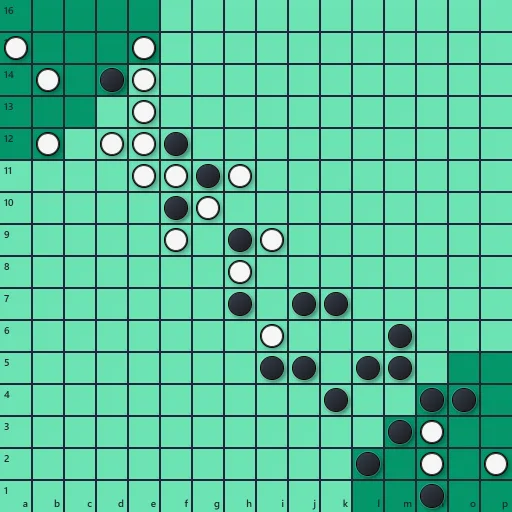
Halma is the original leaping game, invented in 1883 by the American surgeon George Howard Monks, who took his inspiration from an older English game called Hoppity. Its name is the Greek word for 'leap', and leaping is the whole game: on a 16x16 board, each player owns a camp of 19 pieces in one corner and races every one of them into the camp diagonally opposite. Nothing is ever captured. Pieces travel by stepping one square in any direction, or by hopping over a neighbouring piece of either colour into the empty square beyond, chaining hop after hop into ladders that can cross the entire board in a single turn. Halma was later reshaped onto a six-pointed star and sold as Sternhalma, which the world now knows as Chinese Checkers.
How to Play Halma: Learn the Rules
Halma is the original leaping game, invented in 1883 by the American surgeon George Howard Monks, who took his inspiration from an older English game called Hoppity. Its name is the Greek word for 'leap', and leaping is the whole game: on a 16x16 board, each player owns a camp of 19 pieces in one corner and races every one of them into the camp diagonally opposite. Nothing is ever captured. Pieces travel by stepping one square in any direction, or by hopping over a neighbouring piece of either colour into the empty square beyond, chaining hop after hop into ladders that can cross the entire board in a single turn. Halma was later reshaped onto a six-pointed star and sold as Sternhalma, which the world now knows as Chinese Checkers.
Objective
Move all 19 of your pieces out of your own corner camp and into your opponent's camp on the far side of the board. The first player whose pieces fill every square of the opposing camp wins. Because a camp has exactly as many squares as a player has pieces, winning means the whole army has crossed the board.
Setup
The board is a plain grid of 16 by 16 squares. Two camps are marked in diagonally opposite corners, each a staircase of 5, 5, 4, 3 and 2 squares counting outwards from the corner, 19 squares in all. You play the pieces in the bottom-right camp and move first; the computer plays the top-left camp. Every camp square starts occupied by its owner's pieces, and both camps stay marked on the board all game so you can always see the one you are filling.
Gameplay
On your turn you move exactly one piece, in one of two ways. A step moves it one square into an empty neighbouring square, in any of the eight directions, and ends your turn. A hop jumps it over an adjacent piece of either colour into the empty square directly beyond, in a straight line, and may be followed by further hops with the same piece for as long as you find them. You may stop a chain of hops at any point. Pieces are never captured or removed: a piece that has been hopped over simply stays where it is. One restriction applies, and it is the only one in the game: once a piece has arrived in the opposing camp it may never leave, so it can only move to other squares of that camp.
Winning
You win the moment a move leaves all 19 of your pieces standing on the 19 squares of your opponent's camp. There is no capture and no stalemate in Halma, so a game that neither side can win, usually because a player is refusing to vacate their own camp, is drawn by threefold repetition when the same position occurs three times.
Objective
Move all 19 of your pieces out of your own corner camp and into your opponent's camp on the far side of the board. The first player whose pieces fill every square of the opposing camp wins. Because a camp has exactly as many squares as a player has pieces, winning means the whole army has crossed the board.
Setup
The board is a plain grid of 16 by 16 squares. Two camps are marked in diagonally opposite corners, each a staircase of 5, 5, 4, 3 and 2 squares counting outwards from the corner, 19 squares in all. You play the pieces in the bottom-right camp and move first; the computer plays the top-left camp. Every camp square starts occupied by its owner's pieces, and both camps stay marked on the board all game so you can always see the one you are filling.
Gameplay
On your turn you move exactly one piece, in one of two ways. A step moves it one square into an empty neighbouring square, in any of the eight directions, and ends your turn. A hop jumps it over an adjacent piece of either colour into the empty square directly beyond, in a straight line, and may be followed by further hops with the same piece for as long as you find them. You may stop a chain of hops at any point. Pieces are never captured or removed: a piece that has been hopped over simply stays where it is. One restriction applies, and it is the only one in the game: once a piece has arrived in the opposing camp it may never leave, so it can only move to other squares of that camp.
Winning
You win the moment a move leaves all 19 of your pieces standing on the 19 squares of your opponent's camp. There is no capture and no stalemate in Halma, so a game that neither side can win, usually because a player is refusing to vacate their own camp, is drawn by threefold repetition when the same position occurs three times.
Learn, Play, and Have Fun!
Ready to play Halma online? Start a match against the computer now. No signup, no friction.