
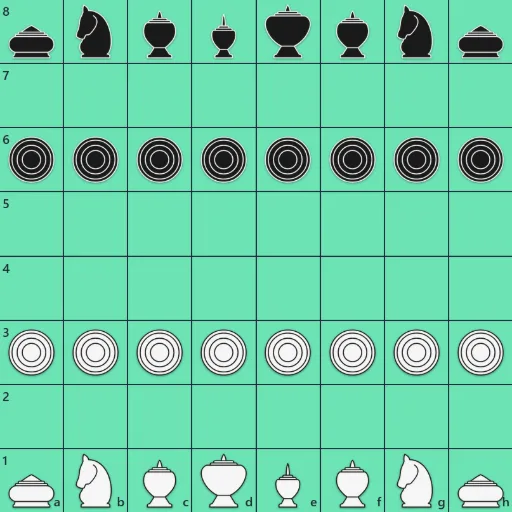
Makruk, also known as Thai Chess, is the traditional chess of Thailand and one of the closest living relatives of the ancient game of chaturanga from which all chess variants descend. Two armies of sixteen pieces face off across an 8x8 board, each trying to checkmate the enemy king, the Khun. Its short-range pieces, pawns that start on the third rank and promote to a counsellor, and the diagonal-stepping Met give Makruk a slower, more maneuvering feel than international chess, rewarding patient positional play.
Makruk Strategy: Tips, Tactics & Openings
Makruk, also known as Thai Chess, is the traditional chess of Thailand and one of the closest living relatives of the ancient game of chaturanga from which all chess variants descend. Two armies of sixteen pieces face off across an 8x8 board, each trying to checkmate the enemy king, the Khun. Its short-range pieces, pawns that start on the third rank and promote to a counsellor, and the diagonal-stepping Met give Makruk a slower, more maneuvering feel than international chess, rewarding patient positional play.
Coordinate Your Short-Range Pieces
The Met and Khon each move only one square, so a lone piece accomplishes little. Advance them together toward the center where they support one another and can join an attack. Slow, coordinated development beats scattering your pieces across the board.
Push Your Bia to Promote
A Bia promotes to a Met the moment it reaches the sixth rank, only two squares from where it starts. Creating and advancing a passed Bia is one of the fastest ways to gain material, since an extra Met is a powerful attacker. Watch for pawn breaks that open a clear path to the promotion rank.
Activate Your Ruea
The Ruea are by far the strongest pieces on the board, the only ones that strike from a distance. Open files for them early and avoid leaving them boxed in behind your own pawns. A pair of active Ruea on open lines often decides the game.
Shelter the Khun Yourself
There is no castling in Makruk, so you must walk your Khun to safety by hand and build a wall of pawns and pieces around it. Do not leave the king in the center once the Ruea come into play. A safe king lets you attack freely without fear of a sudden counterstrike.
Fight for the Center
Because nearly every piece is short-range, controlling the central squares dramatically increases each piece's reach and influence. Contest the center with your Bia and Khon from the opening, and deny your opponent the outposts from which their pieces would otherwise dominate.
Coordinate Your Short-Range Pieces
The Met and Khon each move only one square, so a lone piece accomplishes little. Advance them together toward the center where they support one another and can join an attack. Slow, coordinated development beats scattering your pieces across the board.
Push Your Bia to Promote
A Bia promotes to a Met the moment it reaches the sixth rank, only two squares from where it starts. Creating and advancing a passed Bia is one of the fastest ways to gain material, since an extra Met is a powerful attacker. Watch for pawn breaks that open a clear path to the promotion rank.
Activate Your Ruea
The Ruea are by far the strongest pieces on the board, the only ones that strike from a distance. Open files for them early and avoid leaving them boxed in behind your own pawns. A pair of active Ruea on open lines often decides the game.
Shelter the Khun Yourself
There is no castling in Makruk, so you must walk your Khun to safety by hand and build a wall of pawns and pieces around it. Do not leave the king in the center once the Ruea come into play. A safe king lets you attack freely without fear of a sudden counterstrike.
Fight for the Center
Because nearly every piece is short-range, controlling the central squares dramatically increases each piece's reach and influence. Contest the center with your Bia and Khon from the opening, and deny your opponent the outposts from which their pieces would otherwise dominate.
Learn, Play, and Have Fun!
Ready to play Makruk online? Start a match against the computer now. No signup, no friction.