
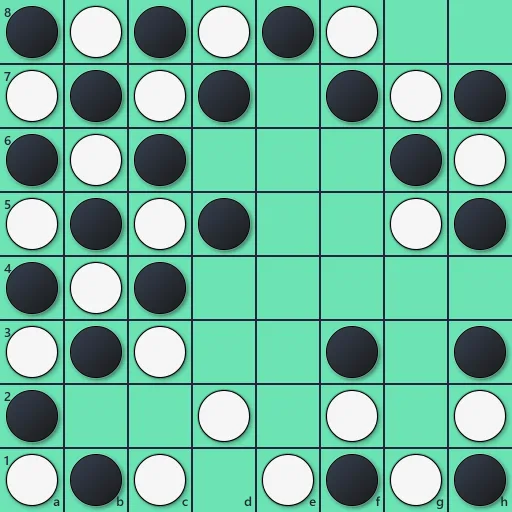
Kōnane is an ancient Hawaiian abstract strategy board game played on a filled 8x8 grid of black and white stones. Each turn you jump one of your own stones over an adjacent enemy stone into the empty space beyond, removing every stone you leap. There is no material goal at all: the first player who cannot jump loses, so Kōnane is a pure contest of mobility.
Kōnane Strategy: Tips, Tactics & Openings
Kōnane is an ancient Hawaiian abstract strategy board game played on a filled 8x8 grid of black and white stones. Each turn you jump one of your own stones over an adjacent enemy stone into the empty space beyond, removing every stone you leap. There is no material goal at all: the first player who cannot jump loses, so Kōnane is a pure contest of mobility.
Count Moves, Not Stones
Kōnane is decided by who runs out of jumps, so material means almost nothing. Before you play, count how many legal jumps each side would have afterwards, not how many stones you would take. A greedy triple jump that opens three fresh replies for your opponent is usually worse than a modest single hop that leaves them nothing.
Keep Moves in Reserve
Spread your available jumps across many different stones rather than piling them onto one. Twenty moves belonging to eight stones survive a capture that would wipe out twenty moves belonging to two. A reserve of independent, unrelated jumps in a quiet corner of the board is what wins the endgame, so create one early and resist spending it.
Play the Edges and Corners
A stone on the outer ring can only be jumped from fewer directions, and a corner stone from fewer still, so edge stones are the hardest for your opponent to strip away. Building your reserve of moves along the border keeps it safe while the centre is being torn open, and the centre is where most of the early exchanges happen.
Open the Board Slowly
Every empty square you create is a landing square your opponent may also use. Long chained jumps feel productive but they hollow out a whole line and often hand the opponent more than they cost. Prefer short jumps that open exactly the space you intend to use yourself, and save the long chains for the moment they actually remove your opponent's last reply.
Watch the Parity
Because the loser is simply the first player with no move, the endgame is a counting problem: if you and your opponent both hold isolated pockets of jumps that cannot interfere with each other, the player with more moves in reserve wins. Learn to spot when the board has split into such independent pockets, then count them and steer play toward the side of the count you are on.
Count Moves, Not Stones
Kōnane is decided by who runs out of jumps, so material means almost nothing. Before you play, count how many legal jumps each side would have afterwards, not how many stones you would take. A greedy triple jump that opens three fresh replies for your opponent is usually worse than a modest single hop that leaves them nothing.
Keep Moves in Reserve
Spread your available jumps across many different stones rather than piling them onto one. Twenty moves belonging to eight stones survive a capture that would wipe out twenty moves belonging to two. A reserve of independent, unrelated jumps in a quiet corner of the board is what wins the endgame, so create one early and resist spending it.
Play the Edges and Corners
A stone on the outer ring can only be jumped from fewer directions, and a corner stone from fewer still, so edge stones are the hardest for your opponent to strip away. Building your reserve of moves along the border keeps it safe while the centre is being torn open, and the centre is where most of the early exchanges happen.
Open the Board Slowly
Every empty square you create is a landing square your opponent may also use. Long chained jumps feel productive but they hollow out a whole line and often hand the opponent more than they cost. Prefer short jumps that open exactly the space you intend to use yourself, and save the long chains for the moment they actually remove your opponent's last reply.
Watch the Parity
Because the loser is simply the first player with no move, the endgame is a counting problem: if you and your opponent both hold isolated pockets of jumps that cannot interfere with each other, the player with more moves in reserve wins. Learn to spot when the board has split into such independent pockets, then count them and steer play toward the side of the count you are on.
Learn, Play, and Have Fun!
Ready to play Kōnane online? Start a match against the computer now. No signup, no friction.