
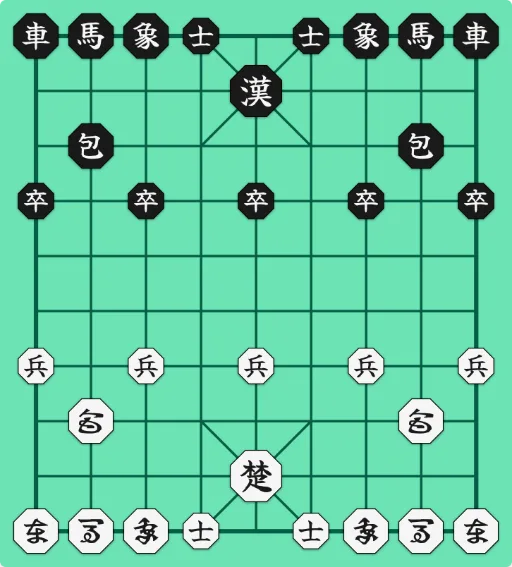
Korean Chess, known in Korea as Janggi, is a classic two-player strategy game descended from the same ancient roots as Chinese Chess. Two armies of sixteen pieces face off across a 9x10 board with no river, each trying to checkmate the enemy general inside its guarded palace. Bold cannons that must leap a screen to move, elephants that stride across the whole board, and generals that patrol the palace diagonals give Janggi a distinctive character all its own.
How to Play Korean Chess: Learn the Rules
Korean Chess, known in Korea as Janggi, is a classic two-player strategy game descended from the same ancient roots as Chinese Chess. Two armies of sixteen pieces face off across a 9x10 board with no river, each trying to checkmate the enemy general inside its guarded palace. Bold cannons that must leap a screen to move, elephants that stride across the whole board, and generals that patrol the palace diagonals give Janggi a distinctive character all its own.
Objective
The goal of Korean Chess is to checkmate the opposing general: to attack it so that it cannot escape capture on the next move. You also win if your opponent is left with no legal move at all. The two armies are traditionally named Han and Cho, one side moves first, and players then alternate turns until a general is trapped.
Setup
Janggi is played on a board of 9 files and 10 ranks, and pieces sit on the intersections rather than inside the squares. There is no river, but each side has a 3x3 palace marked with diagonal lines. Each army has one general, two guards, two elephants, two horses, two chariots, two cannons, and five soldiers. The general begins on the centre point of its palace, and the other pieces line the back rank in front of it. Before play, each side may swap its horse and elephant on either wing, giving several opening formations.
Gameplay
Every piece moves in its own way. The general and the guards move one step along any marked palace line, orthogonally anywhere and diagonally only along the palace diagonals, and none of them may leave the palace. Chariots move any distance in a straight line like a rook, and may also travel along the palace diagonals. Cannons move like chariots but must always jump exactly one screen piece to move or capture, they may never use another cannon as a screen, and they may never capture a cannon. Horses move one point orthogonally then one diagonally, and elephants move one point orthogonally then two diagonally; both are blocked if a point along their path is occupied. Soldiers move one point forward or sideways, never backward, and may step diagonally forward along the enemy palace diagonals.
Winning
You win by delivering checkmate to the enemy general, or by leaving your opponent with no legal move. When your general is threatened with capture you are in check and must answer it immediately. A game can also be drawn, for example by endless repetition of the same position or by the traditional bikjang rule when the two generals face each other down an open file. Patient defence of your palace and relentless pressure on the enemy general are the twin keys to victory.
Objective
The goal of Korean Chess is to checkmate the opposing general: to attack it so that it cannot escape capture on the next move. You also win if your opponent is left with no legal move at all. The two armies are traditionally named Han and Cho, one side moves first, and players then alternate turns until a general is trapped.
Setup
Janggi is played on a board of 9 files and 10 ranks, and pieces sit on the intersections rather than inside the squares. There is no river, but each side has a 3x3 palace marked with diagonal lines. Each army has one general, two guards, two elephants, two horses, two chariots, two cannons, and five soldiers. The general begins on the centre point of its palace, and the other pieces line the back rank in front of it. Before play, each side may swap its horse and elephant on either wing, giving several opening formations.
Gameplay
Every piece moves in its own way. The general and the guards move one step along any marked palace line, orthogonally anywhere and diagonally only along the palace diagonals, and none of them may leave the palace. Chariots move any distance in a straight line like a rook, and may also travel along the palace diagonals. Cannons move like chariots but must always jump exactly one screen piece to move or capture, they may never use another cannon as a screen, and they may never capture a cannon. Horses move one point orthogonally then one diagonally, and elephants move one point orthogonally then two diagonally; both are blocked if a point along their path is occupied. Soldiers move one point forward or sideways, never backward, and may step diagonally forward along the enemy palace diagonals.
Winning
You win by delivering checkmate to the enemy general, or by leaving your opponent with no legal move. When your general is threatened with capture you are in check and must answer it immediately. A game can also be drawn, for example by endless repetition of the same position or by the traditional bikjang rule when the two generals face each other down an open file. Patient defence of your palace and relentless pressure on the enemy general are the twin keys to victory.
Learn, Play, and Have Fun!
Ready to play Korean Chess online? Start a match against the computer now. No signup, no friction.