
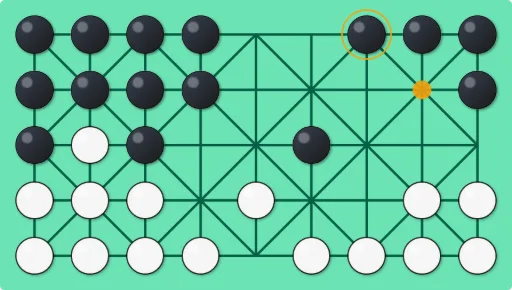
Fanorona is the national board game of Madagascar, played on a 45 point board of 5 rows and 9 columns crossed by diagonals. Each player starts with 22 stones and captures by moving one step toward an enemy line or one step away from it, sweeping off every enemy stone that follows in that direction. Captures are compulsory and can be chained, so a single turn can clear a dozen stones and turn the game around.
Fanorona Strategy: Tips, Tactics & Openings
Fanorona is the national board game of Madagascar, played on a 45 point board of 5 rows and 9 columns crossed by diagonals. Each player starts with 22 stones and captures by moving one step toward an enemy line or one step away from it, sweeping off every enemy stone that follows in that direction. Captures are compulsory and can be chained, so a single turn can clear a dozen stones and turn the game around.
Fight for the Strong Points
Strong intersections carry all 8 lines while weak ones carry only 4, so a stone on a strong point has twice as many ways to move, capture and escape. The centre point is the most powerful square on the board because it is strong and touches the most of the position. Steer your stones on to strong points, and try to leave your opponent standing on weak ones where their options dry up.
Count the Whole Line
A capture takes the entire unbroken run of enemy stones, not just the first one, so before you commit look all the way down the line to the first gap. A capture that looks like one stone may actually be four, and the reverse is also true: leaving a deliberate gap in your own formation limits how much a single enemy move can sweep away.
Weaponise the Forced Capture
Because capturing is compulsory, you can steer your opponent by offering a capture you want them to take. Dangle a single stone so their reply drags a defender out of position, then answer with a chain that collects far more than you gave up. Whenever you plan a move, check what capture it forces on your opponent and whether that helps you.
Chain by Alternating Directions
Within a sequence a stone may not repeat its previous direction or revisit a point, so long chains come from zig-zagging. Look for capture routes that alternate between approach and withdrawal, since withdrawing lets you take stones behind you while moving toward the next target. Remember that stopping is allowed, so end the chain while your stone still sits on a safe strong point.
Keep Your Formation Tight
Long straight lines of your own stones are exactly what an approach or withdrawal capture feeds on, so avoid stacking many stones in an unbroken row pointing at an open lane. Stagger your formation, keep empty points inside it to break up capture runs, and keep supporting stones close enough that a lost stone can be answered immediately.
Fight for the Strong Points
Strong intersections carry all 8 lines while weak ones carry only 4, so a stone on a strong point has twice as many ways to move, capture and escape. The centre point is the most powerful square on the board because it is strong and touches the most of the position. Steer your stones on to strong points, and try to leave your opponent standing on weak ones where their options dry up.
Count the Whole Line
A capture takes the entire unbroken run of enemy stones, not just the first one, so before you commit look all the way down the line to the first gap. A capture that looks like one stone may actually be four, and the reverse is also true: leaving a deliberate gap in your own formation limits how much a single enemy move can sweep away.
Weaponise the Forced Capture
Because capturing is compulsory, you can steer your opponent by offering a capture you want them to take. Dangle a single stone so their reply drags a defender out of position, then answer with a chain that collects far more than you gave up. Whenever you plan a move, check what capture it forces on your opponent and whether that helps you.
Chain by Alternating Directions
Within a sequence a stone may not repeat its previous direction or revisit a point, so long chains come from zig-zagging. Look for capture routes that alternate between approach and withdrawal, since withdrawing lets you take stones behind you while moving toward the next target. Remember that stopping is allowed, so end the chain while your stone still sits on a safe strong point.
Keep Your Formation Tight
Long straight lines of your own stones are exactly what an approach or withdrawal capture feeds on, so avoid stacking many stones in an unbroken row pointing at an open lane. Stagger your formation, keep empty points inside it to break up capture runs, and keep supporting stones close enough that a lost stone can be answered immediately.
Learn, Play, and Have Fun!
Ready to play Fanorona online? Start a match against the computer now. No signup, no friction.