
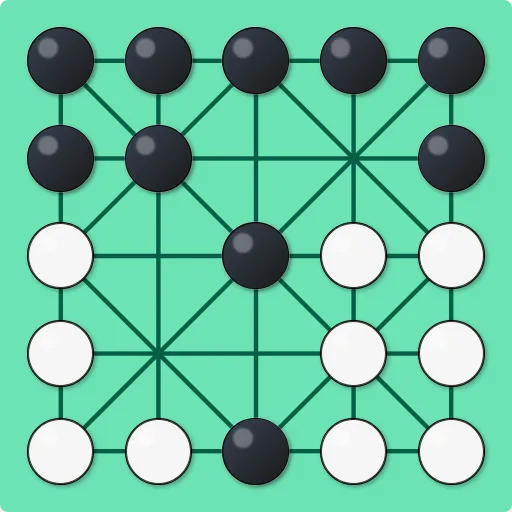
Alquerque is the medieval leap and capture game that draughts grew out of, played on a 25 point board of 5 rows and 5 columns crossed by diagonals. Each player starts with 12 stones and captures by jumping over an adjacent enemy stone to the empty point straight beyond it, exactly the way a checkers piece does. Capturing is compulsory and jumps chain together, so a single stone can sweep several enemies off the board in one turn.
Alquerque Strategy: Tips, Tactics & Openings
Alquerque is the medieval leap and capture game that draughts grew out of, played on a 25 point board of 5 rows and 5 columns crossed by diagonals. Each player starts with 12 stones and captures by jumping over an adjacent enemy stone to the empty point straight beyond it, exactly the way a checkers piece does. Capturing is compulsory and jumps chain together, so a single stone can sweep several enemies off the board in one turn.
Fight for the Strong Points
Strong intersections carry all 8 lines while weak ones carry only 4, so a stone on a strong point has twice as many ways to move, jump and escape. The centre is the most powerful point on the board because it is strong and touches the most of the position, which is exactly why the setup leaves it empty for both sides to fight over. Steer your stones on to strong points, and try to leave your opponent standing on weak ones where their options dry up.
Build the Double Jump
A single capture trades one stone for one stone, but a chain wins the game. Before you move, look for landing points from which your stone would have a second leap waiting, and place your stones so that the enemy pieces you want to take are spaced with empty points behind them. The same reading works in reverse: check every square you move to for the chain your opponent could start there.
Weaponise the Forced Capture
Because capturing is compulsory, you can steer your opponent by offering a jump you want them to take. Dangle a single stone so their forced leap drags a defender out of position or lands it where your own chain begins, then collect far more than you gave up. Whenever you plan a move, check what capture it forces on your opponent and whether that helps you.
Leave No Gaps Behind
A stone can only be jumped when the point directly behind it is empty, so a stone with a friend at its back is safe from that direction. Advance in pairs and blocks rather than as lone runners, and think of every empty point in your own formation as a door you have left open. Filling the point behind a threatened stone is often a better defence than moving the stone away.
Play for the Empty Centre
The opening position is symmetric and completely locked except around the empty centre point, so the first few moves are a fight over who gets to use it. Occupying the centre gives you eight lines of attack, but stepping in carelessly hands your opponent the first capture. Count the exchanges before you commit, and be ready to leave the point empty and win it later when your stones support each other.
Fight for the Strong Points
Strong intersections carry all 8 lines while weak ones carry only 4, so a stone on a strong point has twice as many ways to move, jump and escape. The centre is the most powerful point on the board because it is strong and touches the most of the position, which is exactly why the setup leaves it empty for both sides to fight over. Steer your stones on to strong points, and try to leave your opponent standing on weak ones where their options dry up.
Build the Double Jump
A single capture trades one stone for one stone, but a chain wins the game. Before you move, look for landing points from which your stone would have a second leap waiting, and place your stones so that the enemy pieces you want to take are spaced with empty points behind them. The same reading works in reverse: check every square you move to for the chain your opponent could start there.
Weaponise the Forced Capture
Because capturing is compulsory, you can steer your opponent by offering a jump you want them to take. Dangle a single stone so their forced leap drags a defender out of position or lands it where your own chain begins, then collect far more than you gave up. Whenever you plan a move, check what capture it forces on your opponent and whether that helps you.
Leave No Gaps Behind
A stone can only be jumped when the point directly behind it is empty, so a stone with a friend at its back is safe from that direction. Advance in pairs and blocks rather than as lone runners, and think of every empty point in your own formation as a door you have left open. Filling the point behind a threatened stone is often a better defence than moving the stone away.
Play for the Empty Centre
The opening position is symmetric and completely locked except around the empty centre point, so the first few moves are a fight over who gets to use it. Occupying the centre gives you eight lines of attack, but stepping in carelessly hands your opponent the first capture. Count the exchanges before you commit, and be ready to leave the point empty and win it later when your stones support each other.
Learn, Play, and Have Fun!
Ready to play Alquerque online? Start a match against the computer now. No signup, no friction.