
Shogi, also known as Japanese Chess, is a two-player strategy game played on a 9x9 board where the goal is to checkmate the enemy king. Its defining feature is the drop rule: pieces you capture change sides and can later be placed back onto the board as your own, so material is never truly gone. With promotable pieces, powerful rooks and bishops, and armies that reinforce themselves, Shogi is one of the deepest and most dynamic games in the chess family.
How to Play Shogi: Learn the Rules
Shogi, also known as Japanese Chess, is a two-player strategy game played on a 9x9 board where the goal is to checkmate the enemy king. Its defining feature is the drop rule: pieces you capture change sides and can later be placed back onto the board as your own, so material is never truly gone. With promotable pieces, powerful rooks and bishops, and armies that reinforce themselves, Shogi is one of the deepest and most dynamic games in the chess family.
Objective
The goal of Shogi is to checkmate the opposing king, attacking it so that it cannot avoid capture on the next move. Because captured pieces return to play in the hands of the capturer, attacks build quickly and the board stays full of possibilities. Black (Sente) always moves first, and the players then alternate turns until one king is trapped.
Setup
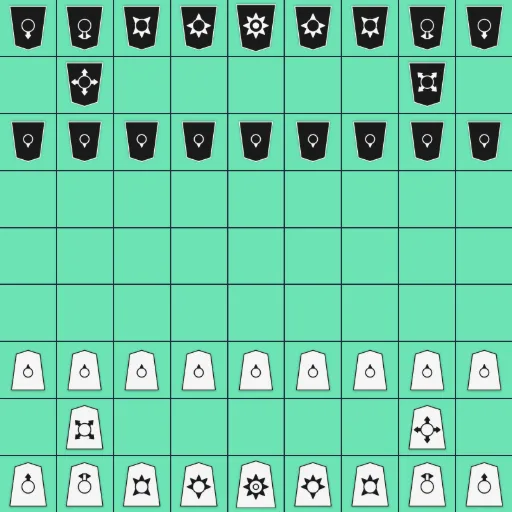
Shogi is played on a 9x9 grid. Each player starts with twenty pieces: one king, one rook, one bishop, two gold generals, two silver generals, two knights, two lances, and nine pawns. The back rank holds, from the edges inward, lance, knight, silver, gold, king, gold, silver, knight, lance. The bishop and rook sit on the second rank near the left and right, and all nine pawns fill the third rank facing the opponent.
Gameplay
Each piece moves in its own way. The king moves one square in any direction. The rook moves any distance orthogonally and the bishop any distance diagonally. Gold generals move one square in any direction except the two backward diagonals, and silver generals move one square straight forward or diagonally in any of the four directions. Knights jump forward to one of two squares and cannot move otherwise, lances slide straight forward any distance, and pawns move and capture one square straight ahead. When a piece moves into, within, or out of the three ranks nearest the opponent it may promote, gaining stronger movement. Instead of a normal move you may also drop a captured piece from your hand onto almost any empty square, immediately making it yours.
Winning
You win by delivering checkmate to the enemy king. When your king is attacked you are in check and must answer the threat at once by moving the king, blocking, or capturing the attacker. There is no stalemate in Shogi, and drawn games are rare, usually arising only from a repeated position. Because captured pieces keep fighting for their new owner, even a material deficit can be reversed, so relentless pressure on the king is the surest path to victory.
Objective
The goal of Shogi is to checkmate the opposing king, attacking it so that it cannot avoid capture on the next move. Because captured pieces return to play in the hands of the capturer, attacks build quickly and the board stays full of possibilities. Black (Sente) always moves first, and the players then alternate turns until one king is trapped.
Setup
Shogi is played on a 9x9 grid. Each player starts with twenty pieces: one king, one rook, one bishop, two gold generals, two silver generals, two knights, two lances, and nine pawns. The back rank holds, from the edges inward, lance, knight, silver, gold, king, gold, silver, knight, lance. The bishop and rook sit on the second rank near the left and right, and all nine pawns fill the third rank facing the opponent.
Gameplay
Each piece moves in its own way. The king moves one square in any direction. The rook moves any distance orthogonally and the bishop any distance diagonally. Gold generals move one square in any direction except the two backward diagonals, and silver generals move one square straight forward or diagonally in any of the four directions. Knights jump forward to one of two squares and cannot move otherwise, lances slide straight forward any distance, and pawns move and capture one square straight ahead. When a piece moves into, within, or out of the three ranks nearest the opponent it may promote, gaining stronger movement. Instead of a normal move you may also drop a captured piece from your hand onto almost any empty square, immediately making it yours.
Winning
You win by delivering checkmate to the enemy king. When your king is attacked you are in check and must answer the threat at once by moving the king, blocking, or capturing the attacker. There is no stalemate in Shogi, and drawn games are rare, usually arising only from a repeated position. Because captured pieces keep fighting for their new owner, even a material deficit can be reversed, so relentless pressure on the king is the surest path to victory.
Learn, Play, and Have Fun!
Ready to play Shogi online? Start a match against the computer now. No signup, no friction.